A virtual receptionist needs your business name and preferred greeting, a short description of what you do, who is on your team and what each person handles, how you want messages delivered, which calls to transfer and when, and answers to the questions callers ask most often. The rest can be built up over the first few weeks.
Handing your phones to someone outside the business can feel like a big step, mostly because you wonder how they could possibly know enough to sound like you. The good news is that a receptionist does not need to know everything you know. They need the right information, set out clearly, and a way to learn the rest as calls come in.
This guide covers what to share before your first call, what helps receptionists deal with common questions, how to set out instructions for different types of call, and what you can leave out altogether.
The essentials to share before your first call
Think of this as the minimum a receptionist needs to answer a call confidently and pass on something useful. Most of it fits on a single page.
- Your business name and greeting. Exactly how you want the phone answered, including whether the receptionist should give their first name. Our guide on answering calls in your company name has greeting examples.
- What you do and who you serve. A few sentences on your services, your customers and the area you cover.
- Your team. Names, roles and what each person deals with, so callers are directed to the right person.
- Your own working hours. When you and your colleagues are available to take a transferred call.
- How you want messages. Email, SMS or an online app, and who receives which messages.
- Transfer rules. Which calls should be put through, to whom, and what to do if that person does not pick up.
- What counts as urgent. A clear definition saves guesswork, for example a client whose case has a deadline today or a customer with a leak.
Information that helps with everyday questions
Callers often ring with the same handful of questions. If the receptionist can answer them on the spot, the caller gets what they need and you get fewer messages to return.
Useful things to share include:
- Your address, parking and directions, if people visit you
- The areas or postcodes you cover
- General pricing guidance you are happy to give out, or a line to use when you would rather quote yourself
- Typical lead times or how bookings work
- Your website and email address
You do not have to write all of this at once. During the free trial, Onwards Answering builds a bank of frequently asked questions about your business, adding answers as real callers ask them. That way the knowledge base reflects what your customers actually want to know, rather than what you guessed they might ask.
Call flows: what to do with each type of call
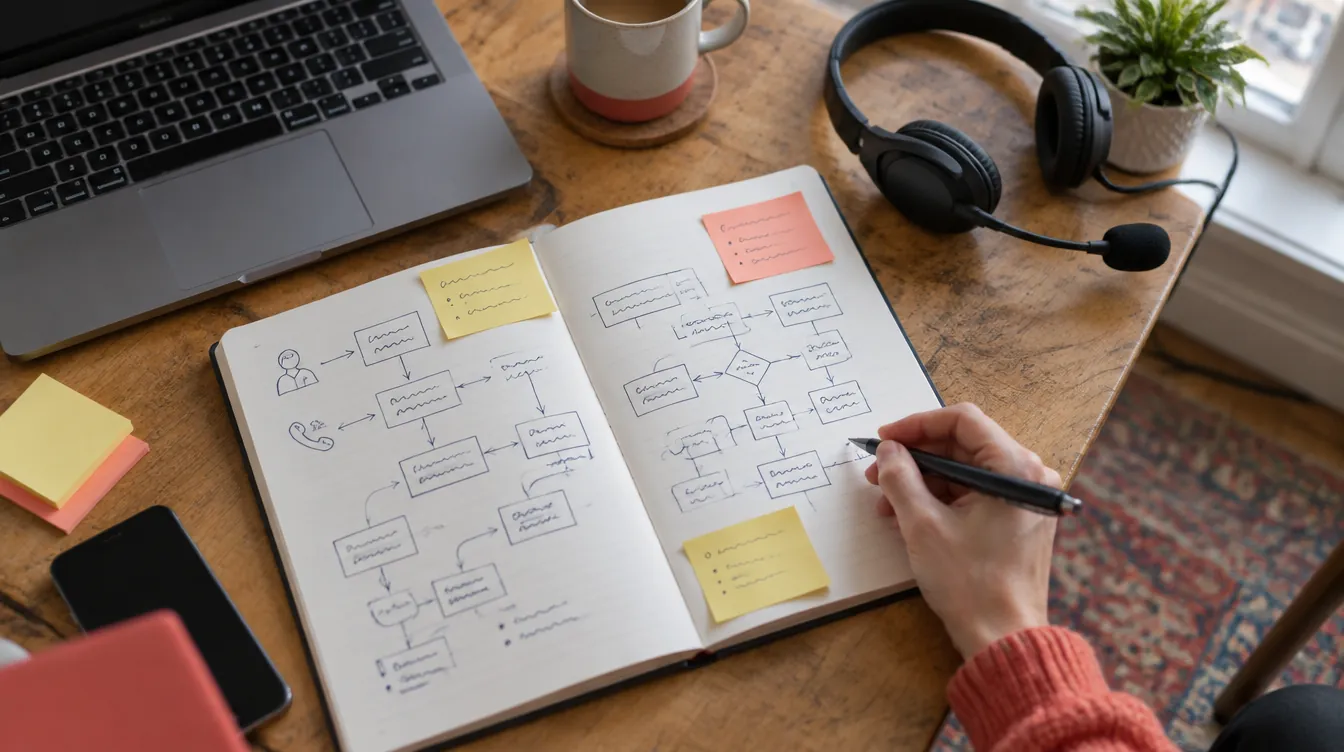
A call flow is simply a set of instructions for each kind of caller. It is the part that turns a polite answering service into something that feels like part of your team. The table below shows a simple way to set it out.
| Type of call | What the receptionist needs | Example instruction |
|---|---|---|
| New enquiry | The details you want captured | Take name, number, email and what they need, then send a message |
| Existing client | Who looks after which clients | Transfer to their contact, or take a message if unavailable |
| Urgent call | Your definition of urgent and who to try | Try a transfer first, then send an SMS straight away |
| Appointment request | Access to your diary and booking rules | Book a suitable slot and confirm the details |
| Sales or supplier call | Whether you want these at all | Take a brief message and mark it as non-urgent |
Different sectors need different details. A construction or trades business will usually want the site postcode and the type of job, while a law firm may want the area of law and whether the caller already has a matter open. If bookings are part of your process, our post on whether a virtual receptionist can book appointments into your diary explains what to share about your calendar.
Tell them what not to say
It is just as helpful to list what the receptionist should avoid. That might be quoting prices, promising a callback time you cannot meet, or confirming whether a named person is a client. A few clear lines here protect you and keep callers' expectations realistic.
What you do not need to provide
A receptionist taking calls on your behalf only needs enough to answer, route and record each call. They do not need access to your full client files, your accounts or anything unrelated to the phone.
Sharing less is also good practice under data protection law. When you use a call answering service, your business is normally the data controller and the service is its processor. Onwards Answering works under UK GDPR and the Data Protection Act, acts as a data processor when handling data for clients, and processes it only in line with client instructions. If you want to check any provider properly, our guide to whether call answering services are GDPR compliant lists the questions to ask.
Keeping your information up to date
Your business changes, so your call instructions should too. Let your answering service know when:
- Someone joins or leaves the team, or changes role
- You are on holiday and calls need to go to someone else
- You launch a new service, change prices or move premises
- A particular type of call is causing confusion
Small updates like these keep calls accurate. Onwards Answering tailors scripts, call flows, responses and greetings to each business, and receptionists can recognise returning callers, which helps regular customers feel known rather than processed. You can read more about this in how Onwards Answering tailors call handling to your business.
How much preparation is enough?
It is easy to put off starting because you feel you need a perfect script. You do not. Start with the essentials, a handful of common questions and a simple call flow, then refine it once you see real messages coming through.
If you are wondering how quickly this all comes together, our guide on how long it takes to set up a call answering service walks through the typical steps.
Getting started with Onwards Answering
Onwards Answering provides a virtual receptionist service run by real receptionists based in Scotland, working from home rather than in a call centre. Calls are answered live during business hours, with an after-hours voicemail option included at no extra cost.
You can try it with a free 2 week trial, during which the team gets to know your business and builds your FAQ bank. After that, prices start from £72 per month, with no per-call charges. See the prices and plans or contact the team to talk through what your callers need.
Frequently asked questions
Do I need to write a full script for a virtual receptionist?
No. A short brief covering your greeting, what you do, who is on your team, how to handle each type of call and how you want messages is enough to start. Onwards Answering tailors scripts and call flows for you and builds a bank of frequently asked questions during the free trial.
Should I give a virtual receptionist access to my client records?
Usually not. A receptionist only needs enough information to answer, route and record calls. Sharing less is good data protection practice, because your business is normally the controller and the answering service is its processor, handling data only on your instructions.
How often should I update my call instructions?
Update them whenever something changes that affects callers, such as new staff, holidays, new services, price changes or a move. It also helps to review messages after the first few weeks and adjust any instructions that are causing confusion or extra follow-up work.