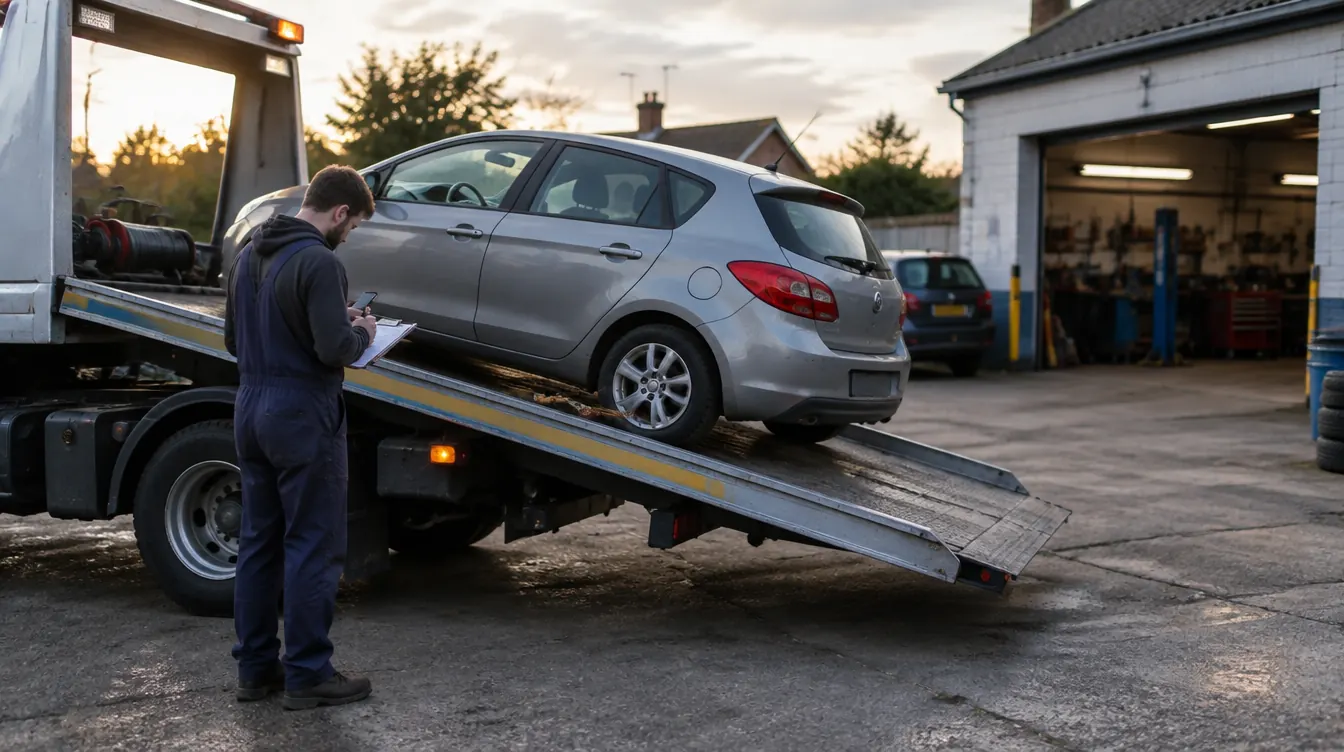
Put safety first: if the driver is in danger on a motorway or live lane, tell them to call 999 before anything else. Then ask whether they have breakdown cover, because their provider often recovers the car first. Capture the location, vehicle, symptoms and destination, sort the call into today or this week by your rules, put urgent calls straight through and never diagnose the fault.
Most garage calls start with "can I book my MOT?". Breakdown calls start differently: a driver on a hard shoulder with the hazards flashing, a car that died in a supermarket car park, or a recovery driver asking where to drop a vehicle. Those calls need a different order of questions. Safety comes first, then whether the driver has breakdown cover, then the details your workshop needs to decide whether the job is for today or later in the week.
What should happen first when a broken-down driver rings?
Check that the caller is safe before anything else. If they are on a motorway or a live lane and not in a safe place, the script tells them to call 999 first. Your garage arranges recovery or repairs only once the driver is out of danger.
The National Highways advice on motorway breakdowns is clear. Leave at the next exit or services if possible. Otherwise pull into an emergency area, lay-by or hard shoulder, stop as far left as possible and put the hazard lights on. If it is safe, get out on the side away from traffic, get behind a safety barrier and do not return to the vehicle. If you cannot get to a place of relative safety, stay in the vehicle with seatbelts on and call 999. Highway Code rules 274 to 287 cover breakdowns and incidents in full.
Whoever answers your phone is not there to coach a driver through a live lane. The script line is short: "Are you somewhere safe, away from the traffic? If you are in danger, please call 999 now, then ring us back once you are safe." That line comes before any other question.
Does the driver already have breakdown cover?
Many drivers do, and their provider will often recover the car first. That changes what the call is about. Rather than "can you come and get me?", the call to your garage is often "my car is being recovered, can you take it in?", sometimes made from the roadside while the driver waits.
So ask early whether the driver has cover and which provider it is with. If they do, the useful answer is whether you can accept the car and where it should be dropped, so the vehicle comes to your yard rather than somewhere else. If they do not, follow your own rules: pass the call to whoever arranges recovery for you, or explain what you can and cannot offer. Our page on call answering for garages shows how rules like these become part of your script.
What should you capture on a breakdown or recovery call?
A good breakdown call gives the workshop enough to plan without ringing the driver back. Use this checklist, in this order:
- Whether the driver, any passengers and the vehicle are in a safe place
- The driver's name and a mobile number that will be answered
- Exact location: road, junction, postcode or a landmark
- Make, model and registration
- What happened, in the driver's own words, and any warning lights
- Whether they have breakdown cover, and which provider
- Whether the car has already been recovered, and where it is now
- Where they want the car taken, and whether that can be your garage
- Any deadline the driver mentions, such as needing the car for work
Recovery company guides list much the same details. Keeping safety and location at the top means the most important facts are confirmed even if the call drops halfway through.
How do you sort breakdown calls into today and this week?
Not every breakdown call is urgent for the workshop. A stranded driver with no cover is a today problem; a car already sitting on your forecourt after recovery may be a this-week job. Agree the categories with your team so whoever answers sorts calls the same way every time. The table below is a starting point to adapt.
| What the caller describes | Category | What the call handler does |
|---|---|---|
| In danger on a motorway or live lane | Emergency, not a garage call yet | Tells them to call 999 first and ring back once safe |
| Broken down in a safe place, no breakdown cover, wants help now | Today | Puts the call straight through, or passes details to your recovery contact, under your rules |
| Provider is recovering the car and the driver wants it brought to you | Today | Confirms whether you can accept it, gives the drop-off address and books the car in |
| Car already recovered to your yard or the driver's home | This week, unless your rules say otherwise | Books a slot and takes the details for the technician |
| Warning light on and the car is still being driven | Your technician decides | Takes the details and passes them on; never says whether the car is safe to drive |
The middle column is yours to set. A garage that runs its own recovery truck will draw the lines differently from one that only accepts recovered vehicles, and that is fine as long as it is written down.
Which breakdown calls should go straight through to the workshop?
Decide in advance which calls interrupt the workshop and which become a message. Common choices are a stranded driver with no cover, a recovery driver on the way who needs a drop-off point, a regular business or fleet customer, and anyone who asks for a technician by name. Everything else can arrive as a written summary to read between jobs.
A warm transfer works best here: the receptionist takes the details, rings the workshop, explains who is calling and why, and then connects the caller. Our guide to whether an answering service can transfer calls to you or your team explains how that works in practice.
Why should the person on the phone never diagnose the fault?
Drivers who have broken down are worried and want answers. "Is it the clutch?", "Is it safe to drive home?" and "How much will it be?" are fair questions, but only a technician who has seen the car can answer them. A wrong guess on the phone could put a driver back on the road in an unsafe car, or set a price the workshop cannot honour.
So the script draws a firm line. The receptionist records symptoms in the driver's own words, the warning lights they can see and when the problem started, then passes it all to the technician. They quote only from a price list you provide and never say whether a car is safe to drive. That sits well with the five most important rules of call handling, and with the booking advice in our guide on how a garage can stop missing MOT and service bookings.
How Onwards Answering handles breakdown calls for garages
Onwards receptionists answer live during business hours in your garage's name and follow your breakdown script: the safety question first, then your checklist, then your rules on transfers and bookings. Urgent calls are put straight through or flagged as urgent, and you receive a call summary by email or SMS after every call. Our telephone answering service can cover every call or only the ones the front desk misses.
Be clear about evenings and weekends. Outside business hours, an included voicemail service records messages, but voicemail is not emergency cover. If your garage offers night-time recovery, keep your own out-of-hours arrangement; our article on what happens to calls outside office hours explains the options, and our guide on whether an answering service can handle emergency call-outs looks at the same question for trades. There is a free 2 week trial, then prices from £72 per month with no per-call charges. Compare packages on our prices and plans page.
Frequently asked questions
Should a garage tell a driver which breakdown provider to call?
No. What a driver's breakdown cover includes is between the driver and their provider. The receptionist can explain what your garage offers, such as accepting recovered vehicles or arranging recovery through your own contact, and take the details. Any advice about the driver's policy should come from the provider, not from your phone line.
Can a receptionist arrange recovery for a stranded driver?
They can follow your rules for it. That might mean putting the call straight through to you, passing the location and vehicle details to your recovery contact, or making a call on your behalf. The receptionist does not decide whether a car can be driven or towed; that judgement stays with you and your recovery partner.
What if the driver cannot give an exact location?
Ask for whatever they can see: the road name or number, the last junction or services they passed, the direction of travel, a postcode on a nearby sign or a landmark. Write down exactly what they say. If they are unsure where they are and feel in danger on the road, the script tells them to call 999 first.